
Classroom Article
Back to ClassroomWhat Type of Wood Is This? A Step-by-Step Way to Identify Any Piece of Wood

Agritix
8 Nov 2026
5 mins read
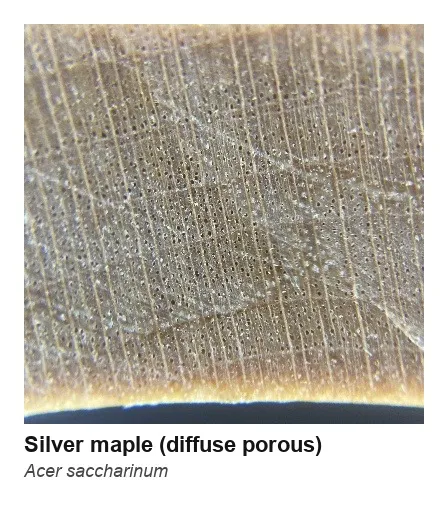
Silver maple (Acer saccharinum) end grain: small pores spread evenly through the ring, a classic diffuse-porous wood. Image: Xylorix.
Quick answer: The most useful characteristics for identifying a wood, in order of decreasing usefulness, are (1) the wood’s anatomical appearance on the end grain (or cross section), usually examined with a magnifier or microscope; (2) the wood’s color and figure; and (3) its weight and hardness. Examining the wood’s end grain is one of the most reliable means of visual-based identification because each wood species has a distinctive cell arrangement. Color, by contrast, is the least reliable characteristic and should be used only as a supporting means of identification (Hoadley, 1990; Wiedenhoeft and Miller, 2005).
Wood Identification Made Simple: The Key Features to Look For
Here is a quick guide to identifying wood without laboratory equipment. Using the methodology of wood anatomists (wood anatomists differentiate wood by looking at clean cross-sections, not surfaces; see ref. below), you will be able to tell the difference between them by looking at a few key features. (ref. Method of making anatomical wood identification, 1989 by the International Association of Wood Anatomists, commonly referred to as the "IAWA Committee".
Why getting it right matters
Is your wood what it says it is? Wood products are mislabelled more than you might think. In fact, when researchers used forensic wood anatomy to identify wood from 73 products for sale at major US retailers, they found that 62% of the products had at least one false or misleading claim, and 55% included wood not listed on the label (Wiedenhoeft et al. 2019).
Where to start when identifying wood
The best place to start when identifying a wood species is by looking at the end grain of a piece. This will show the arrangement of the wood’s vessels (or pores), rays, and growth rings, which are like a fingerprint for each species (Hoadley 1990). These are more reliable than other features, like color, which can vary widely between pieces and over time.
To read it, make a clean cross-cut, pare or sand it smooth so the cells aren't crushed, and look at it through a 10x hand lens (Hoadley, 1990). You are checking:
- Vessels (pores): how big they are, and whether you can see them without a lens
- Pore arrangement: how the pores are spread across each growth ring
- Rays: the lines of tissue running outward from the centre, and how wide they are
- Growth rings: whether the change from earlywood to latewood is sharp or gradual
These are among the core features in the standard reference list wood anatomists use worldwide (IAWA Committee, 1989).
Sort hardwoods by pore arrangement
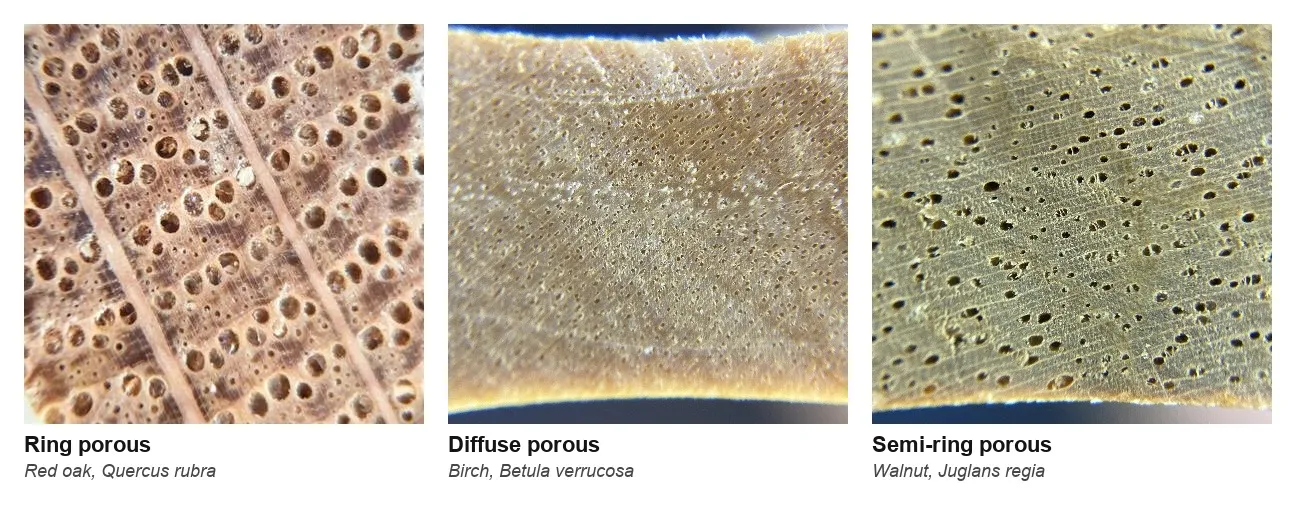
Left to right: ring porous, diffuse porous, and semi-ring porous end grain. Image: Xylorix PocketWood.
--
In hardwoods, the way pores are distributed across a growth ring puts a sample into one of three groups. It is one of the fastest ways to narrow the field (Hoadley, 1990; USDA Forest Products Laboratory, 2010):
| Arrangement | What you see | Typical species |
|---|---|---|
| Ring porous | Large pores bunched at the start of each growth ring | Oak, ash, elm |
| Diffuse porous | Similar-sized pores spread evenly through the ring | Maple, cherry, birch |
| Semi-ring porous | A gradient between the two | Walnut |
Softwoods (conifers such as pine, spruce and cedar) have no vessels. They are built from tracheids instead, so a clean end grain with no visible pores usually means you are holding a softwood (Wiedenhoeft and Miller, 2005).
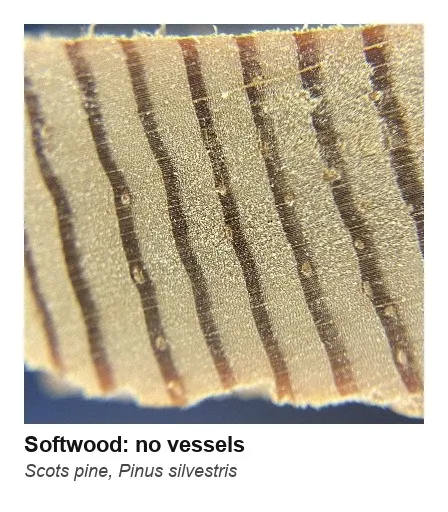
Softwood end grain: no vessels, just even tracheids,clear growth rings and occasional resin canals. Image: Xylorix PocketWood.
--
Use rays, weight, and odor to confirm
Ray width is useful as secondary evidence. Oak has tall rays, which give the fleck on quarter-sawn oak boards. With many diffuse-porous woods, you won't see any rays unless you use a magnifying glass (Hoadley, 1990). Other characteristics such as density, hardness, figure, and smell can all help you choose between two woods when anatomical features point to both possibilities. Some woods have a distinctive smell when freshly cut, such as cedar and teak. However, these characteristics can only point you in the right direction and shouldn't be relied on for a definitive decision.
Don't trust colour
While color is the first characteristic most people use to identify wood species, it is one of the least reliable. It varies with finish, light, moisture content, and age, among other factors (Hoadley, 1990). Even the heartwood of a single species can vary widely in color, and different species can sometimes be very similar in color, especially when finished. Thus, wood should be identified based on its anatomical characteristics, and color should only be used to support the conclusion
Common mistakes that lead to the wrong answer
Some common mistakes that can lead to misidentification of wood are (adapted from Hoadley 1990): Reading a rough cut. Don’t try to read the end grain of a piece of wood that has been sawn or roughly cut. Sawing crushes the cells and can smear over the pores, for example, making a ring-porous wood appear diffuse-porous. Pare off the end grain with a knife or sand it to expose the cells properly.
- Judging from sapwood. Don’t try to identify a piece of wood from sapwood alone. The sapwood of many different species can look very similar. Try to find a piece with heartwood.
- Relying on one clue. Don’t try to identify a piece of wood by one feature only. Look at several features to help you differentiate between similar species.
- Skipping the reference. Don’t try to identify a piece of wood without comparing it to images in a reference.
Free reference collections worth knowing
If you don't want to build your own reference library, you can always check out some of the many online resources. The most comprehensive is likely InsideWood, hosted by North Carolina State University Libraries, with over 10,000 wood anatomy descriptions and over 77,000 images, mostly modern hardwoods (InsideWood, n.d.). The Wood Database provides information on many commercial wood species, including hardness, weight, etc., and even end-grain photos (Meier, E., n.d.). If you're more interested in macroscopic characteristics, the PocketWood app includes many end-grain images at a size you can view on your mobile phone for easy comparison.
Confirm the species without a lab
The main limitation in wood identification is the lack of magnification to take clear photos of wood end grain. Many people have tried taking pictures with their mobile phone, and it’s just not possible.
Several macro lenses work well with your mobile phone. You can use them to take pictures and then compare the macroscopic features with those in the PocketWood FREE app, which includes photos of the wood end grain of thousands of species from around the world. Alternatively, you can use the Xylorix Inspector app with the WIDK-24X01 macro lens to photograph the wood end grain. Using advanced artificial intelligence models of selected wood species validated by wood anatomists, the app can tell you what wood you have in just a few seconds.
Frequently asked questions
What is the most reliable way to identify wood?
You can identify wood by looking at the pattern of vessels and rays on the end grain with a magnifier. This is much better than any other method that involves looking at the color or grain on the wood surface (Hoadley, 1990).
Can I identify wood from a photo?
From a good photo of a sanded surface, you can narrow down the number of possible wood species. If you can take a photo of the wood's end grain with a magnifier, you can identify the wood.
Do I need special tools to identify wood species?
With a good photo of a sanded surface, you can narrow down the number of possible wood species. If you can take a photo of the wood's end grain with a magnifier, you can identify the wood.
Can wood species be identified by color?
You can’t identify wood species by color. Color is influenced by the wood finish, lighting, and the wood's age. Even within the same wood species, wood color varies (Hoadley, 1990).
How common is mislabelled wood?
Wood is surprisingly often sold under the wrong name. In the US, 62% of wood products tested at retail outlets contained at least one false or misleading claim (Wiedenhoeft et al., 2019).
References
Hoadley, R.B. (1990) Identifying Wood: Accurate Results with Simple Tools. Newtown, CT: Taunton Press. Available at: https://openlibrary.org/isbn/9780942391046
IAWA Committee (1989) 'IAWA list of microscopic features for hardwood identification', IAWA Bulletin, n.s. 10(3), pp. 219-332. Available at: https://catalog.hathitrust.org/Record/009135990
USDA Forest Products Laboratory (2010) Wood Handbook: Wood as an Engineering Material (General Technical Report FPL-GTR-190). Madison, WI: U.S. Department of Agriculture, Forest Service, Forest Products Laboratory. Available at: https://www.ucanr.edu/site/woody-biomass-utilization/wood-handbook
Wiedenhoeft, A.C. and Miller, R.B. (2005) 'Structure and function of wood', in Rowell, R.M. (ed.) Handbook of Wood Chemistry and Wood Composites. Boca Raton, FL: CRC Press, pp. 9-33. Available at: https://openlibrary.org/isbn/9780849315886
Wiedenhoeft, A.C., Simeone, J., Smith, A., Parker-Forney, M., Soares, R. and Fishman, A. (2019) 'Fraud and misrepresentation in retail forest products exceeds U.S. forensic wood science capacity', PLoS ONE, 14(7), e0219917. Available at: https://doi.org/10.1371/journal.pone.0219917
InsideWood (n.d.) InsideWood Database. North Carolina State University Libraries. Available at: https://insidewood.lib.ncsu.edu/ (Accessed: 14 October 2026).
Meier, E. (n.d.) The Wood Database. Available at: https://www.wood-database.com (Accessed: 14 October 2026).
Got a piece of wood you want to identify? Download PocketWood to browse reference end grain images, or pair the Xylorix Inspector app with the WIDK-24X01 lens to capture your own end grain and get an identification in seconds.
-- Prepared By Xylorix
Have any question or comment? Send us a message here
Thanks for reading the article! If you like it or wanting to see more of these articles, be sure to check out our Facebook and LinkedIn page where we keep our users updated when there's new article enter the series. 🥰