
Classroom Article
Back to ClassroomWhy is Wood Identification Needed?
A brief look into the history and its various applications

Agritix
29 Jan 2021
3 mins read

A stack of woods.
Introduction
In the early days of Malaya (during the British colonial era), wood identifications were mainly carried out for the government departments, the municipalities of Singapore and Penang, and private firms and individuals. In other part of the world like Britain, France and some European countries, wood identification was important as a large volume of logs and timber were extracted from the forest of their colonies in Africa, Central America and South East Asia for construction purposes.
Nowadays, wood identification services cover a wide range of work which includes research and training, trade and industry, historical building conservation, trade dispute, government enforcement agencies like custom, import and export of timber and timber products, forensic science, illegal logging and possibly other uses.
Wood Processing
In the wood processing industry, knowing the type of timber used is important as for example, different timbers have different drying, machining and finishing properties. In the case of drying for example, the drying protocols for a light timber like rubberwood (Hevea brasiliensis) are different from a heavy timber like merbau (Intsia palembanica). Wood drying is a vital process where the moisture content within the woods are reduced by various methods prior to its usage. One of the conventional methods is through air drying where the sawn timbers are arranged in a stacked manner with open airways. Similar principles also apply to the processing and finishing of wood.
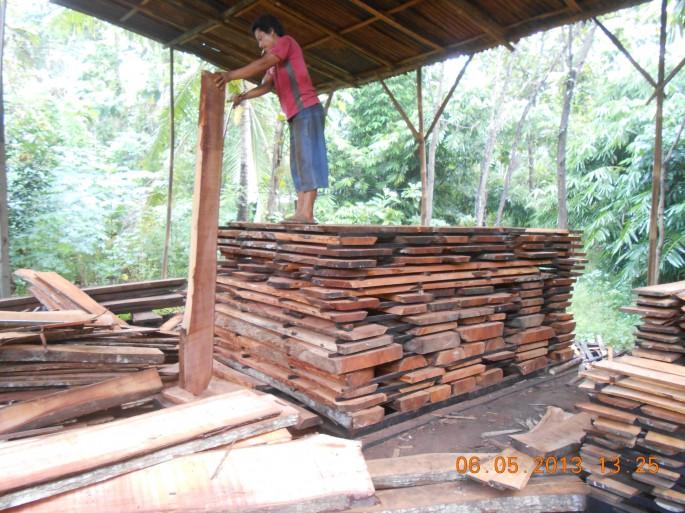
Picture here shown a unique air drying method employed by the indigenous in Jelapa, Indonesia using smog of wood waste burned in a traditional stove to dry the stacked timbers.
Trades, Disputes and Forensics
In the international trade, customs officials need to know whether logs, timbers, or wood products are correctly labelled so that tariffs can be properly assessed and trade regulations enforced. Verifying the source and identity of timber in order to enforce bans on trade in woods of endangered species will require wood identification skills too. In Malaysia and Singapore, wood anatomists have been called upon to provide expert opinion in trade disputes on the identity of timber by the court of law.
Knowledge on wood anatomy in the field of forensic science is proven to be useful as well as shown in the Lindberg’s baby kidnapping case in 1930s in USA where the analysis of the wooden ladder used provided crucial evidence for the conviction of the alleged kidnapper. During the investigation, a wood expert, Arthur Koehler from the Forest Service, United States Department of Agriculture was called in to examine the details of the ladder such as its wood type and built pattern, which are summarized in his report that later played in critical role in the kidnapper’s trial.

Wanted poster of the kidnapped child, son of Charles Augustus Linbergh.
--
fbi.govBuilding Restoration
In the restoration of heritage building, the need to check on the identity of the original timber used so that similar type of timber can be used to replace the damaged or decayed pieces e.g. the restoration of Cheng Hoon Teng (Chinese: 青云亭) temple (oldest temple in Malaysia- close to 400 years old) in Malacca. Wood identification is also important in archaeological works and the identity of wood used in the building of ships that were sunk long ago.

Founded in the era of Dutch Malacca around 1645 by the Chinese Kapitan Tay Kie Ki, Chen Hoon Teng temple remains one of the popular tourist spots in Malacca, Malaysia.
--
Wiki
-- Prepared By Xylorix Wood Experts Panel
Have any question or comment? Send us a message here
Thanks for reading the article! If you like it or wanting to see more of these articles, be sure to check out our Facebook and LinkedIn page where we keep our users updated when there's new article enter the series. 🥰