
Classroom Article
Back to ClassroomRed Oak vs White Oak: How to Tell Them Apart on the End Grain

Agritix
22 Nov 2026
3 mins read
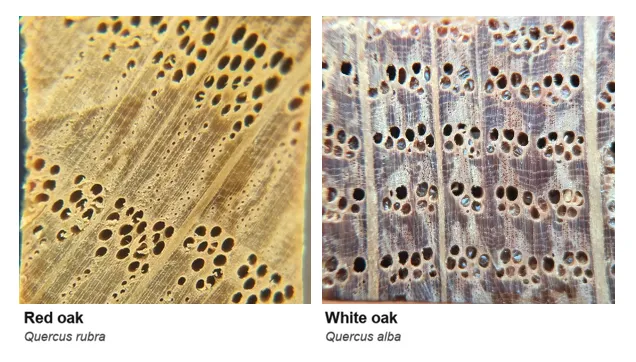
Red oak (left) and white oak (right) end grain under magnification. Image: Xylorix.
Article overview: If you have a piece of wood to examine, the quickest way to distinguish red from white oak is to look at the large earlywood pores in the heartwood end grain with a hand lens. In white oak species, the pores are typically plugged with tyloses (bubbles), whereas in red oak species, the pores are open (Hoadley 1990, Meier E n.d.). Although a few white oak species lack tyloses, most have plentiful tyloses in the heartwood, but fewer in the sapwood, and red oak can occasionally show a few. WoodWeb also recommends checking ray length (WoodWeb n.d.).
On a finished board, red and white oak look almost identical, and color won't reliably separate them. The real difference is hidden inside the vessels. Once you know where to look, it takes seconds.
The tyloses test
White oak and red oak differ because white oak has tyloses. Tyloses are outgrowths that fill the wood's vessels, giving it a more watertight quality that makes it ideal for barrels and boats. This characteristic is the best way to identify white oak (Hoadley, 1990; Meier E, n.d.).
To see this characteristic, make a clean knife cut on a piece of white oak or red oak, and examine the large pores on the end grain of the heartwood. The large, earlywood pores occur in a band at the start of each growth ring. In a white oak, the pores will look blocked, filled in with a shiny, foam-like substance. In red oak, the pores are open, like tiny straws.
To see the pores clearly, clean the wood surface before inspecting it. Sawdust that is stuck in the pores can look similar to tyloses (WoodWeb, n.d.).
Supporting features
Once the pores point one way, these features should line up behind them (Hoadley, 1990; WoodWeb, n.d., Wood Floor Business, Maryland Archaeological Conservation Lab):
| Feature | Red oak | White oak |
|---|---|---|
| Earlywood pores | Open | Plugged with tyloses |
| Ray length (flatsawn face) | Shorter, usually under 3/4 inch, rarely over 1 inch | Longer, often over 1 inch |
| Typical tone | Pinkish to reddish | Greyer, olive to tan |
| Latewood pores | Fewer, larger, round and thick-walled; countable with a lens | Very numerous, small, angular and thin-walled; too many to count |
Ray length is often the more dependable field check, because it works on both heartwood and sapwood (WoodWeb, n.d.). It isn’t failsafe on its own, so confirm with the latewood pores.
Why the difference matters in use
This is more than a simple question of nomenclature. White oak has a heartwood considered very durable and is traditionally used in boat building and tight cooperage (barrels that hold liquids without leaking) (Meier E, n.d.). Red oak is considered non-durable to perishable, with poor insect resistance and a tendency to stain and discolor when exposed to water, particularly in the more porous parts of the growth rings (Meier E, n.d.). White oak is also harder (1350 lbf) than red oak (1220 lbf) (Meier E, n.d.).
If you sell red oak as white oak for outdoor furniture, decking, boat parts, or holding liquids in a barrel, expect it to fail quickly. If you're using the wood indoors for cabinetry and trim, either oak will work well.
Color can be misleading
The terms "red" and "white" apply to groups of woods whose color varies widely by finish, species, and even lighting. Sometimes they even seem to reverse (Hoadley, 1990). The most reliable way to identify these woods is to examine their end-grain (the cut end of a board or log) features.
Confirm it with a macro lens
Even though they are very small, the details of the pores and tyloses come through clearly. It doesn’t take much magnification to tell them apart. If you would like to compare your own end grain to these images, PocketWood has many great reference images of both oaks, and you can compare them side by side. We captured this using the Xylorix Inspector app and the WIDK-24X01 macro lens. If you would like to capture your own end-grain images for AI-assisted identification, this is a great way to sort through your stock or parts and see what you have.
How do you know the difference between red oak and white oak?
You can look at the pores on the end grain of the earlywood of a piece of heartwood. White oak pores are filled with tyloses, and red oak pores are open. You can also check the small latewood pores, which are few and countable in red oak but numerous and uncountable in white oak, and the ray length on a flatsawn surface.
Can you blow through a piece of red oak?
You can often blow through a piece of red oak, but some white oak pieces will let air through as well, so this isn't the best way to tell the difference. (Woodweb, n.d.)
Is white oak usually more grey than red oak?
White oak is usually more grey than red oak, but again, this isn't the best way to tell the difference between the two. (Meier, n.d.)
How do you tell if a piece of furniture is made from red or white oak?
Look for exposed end grain on hidden areas such as the underside of a tabletop, drawer sides or leg bottoms, and check ray length on any flatsawn surface.
Can red oak be used outdoors?
Red oak is not a good wood for outdoor use. Red oak has a durability rating of non-durable/perishable, while white oak is rated very durable. White oak is often used to make boats and barrels. (Meier, n.d.)
References
All sources below are free to read online except where marked.
Meier, E. (n.d.) The Wood Database: Red Oak and White Oak. Available at: https://www.wood-database.com/red-oak/ and https://www.wood-database.com/white-oak/ (Accessed: 13 October 2026).
WoodWeb (n.d.) Distinguishing White Oak from Red (Knowledge Base). Available at: https://woodweb.com/knowledge_base/Distinguishing_White_Oak_from_Red.html (Accessed: 13 October 2026).
USDA Forest Products Laboratory (2010) Wood Handbook: Wood as an Engineering Material (FPL-GTR-190). Available at: https://www.ucanr.edu/site/woody-biomass-utilization/wood-handbook (Accessed: 13 October 2026).
Hoadley, R.B. (1990) Identifying Wood: Accurate Results with Simple Tools. Taunton Press. [Book, not free online; catalogue: https://openlibrary.org/isbn/9780942391046]
Maryland Archaeological Conservation Lab (Jefferson Patterson Park): The Oaks. https://apps.jefpat.maryland.gov/WoodAndCharcoalID/Webpages-trees/TheOaks.htm
Wood Floor Business: Red Oak vs. White Oak: Can You Tell the Difference? https://www.woodfloorbusiness.com/installation/red-oak-vs-white-oak-can-you-tell-the-difference.html
Sorting oak and want to be certain? Browse reference end grain in PocketWood, or capture your own with the WIDK-24X01 lens for a result you can keep on record.
-- Prepared By Xylorix
Have any question or comment? Send us a message here
Thanks for reading the article! If you like it or wanting to see more of these articles, be sure to check out our Facebook and LinkedIn page where we keep our users updated when there's new article enter the series. 🥰